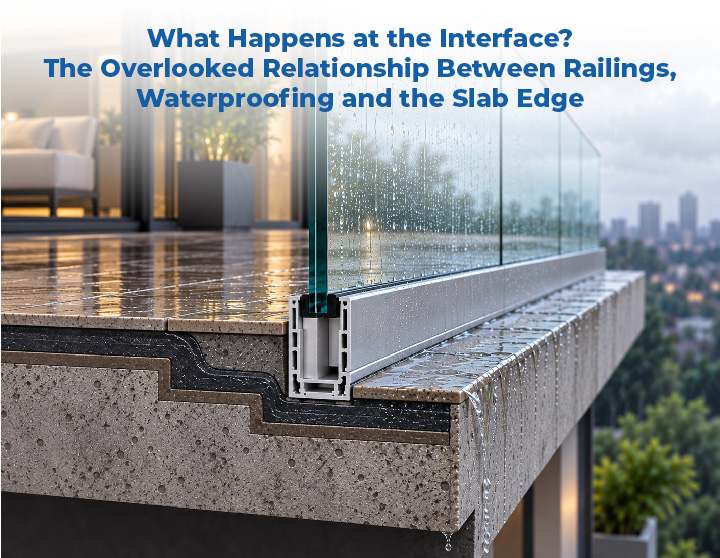
A railing mock-up is often seen as a visual sample. However, for architects and project teams, it should be treated as a technical and design checkpoint.
Before approving a railing system, the mock-up must be evaluated for safety, proportion, finish, alignment, glass integration, and installation logic.
Proportion and Visual Balance
The first thing architects should evaluate is proportion. The railing height, profile thickness, glass clarity, and overall scale must suit the architecture.
A railing that looks elegant in isolation may not suit the actual building context.
Finish Quality
Surface finish must be reviewed carefully. Rough edges, inconsistent coating, scratches, visible marks, or poor joint quality can become larger issues when repeated across the project.
The mock-up should reveal the expected finish standard.
Alignment and Fitment
A mock-up should show how accurately the system fits together. Posts, profiles, glass panels, connectors, and handrails must align cleanly.
Fitment quality directly affects both appearance and performance.
Installation Method
Architects should also evaluate how the railing will be installed. Fixing details, anchoring, slab connection, and site sequence matter.
A beautiful sample is not enough if the installation method is complicated or unreliable.
Safety and Stability
The mock-up should feel stable and secure. It must reflect the strength and confidence expected from the final system.
Safety should be evaluated before visual approval is given.
Conclusion
A railing mock-up is not just a sample. It is a preview of how the railing will look, perform, and integrate with the project.
Technoraill supports premium projects with modular railing systems, precision detailing, premium finishes, and technical support. For architects who need clarity before approval, Technoraill provides railing solutions designed with both design and execution in mind.